Your Airstream’s power system is one of the most important to understand if you want to take full advantage of its onboard amenities. From power consumption to current flow, batteries to shore power, solar, generators, and more, we’re exploring what it takes to power you Airstream life in a multi-part series on the Airstream electrical system. Read more about Airstream Power Systems here.
 An electric field is formed when opposite charges are separated. This separation is accomplished in the cells by coating the two pieces of silicon with materials that give each a positive or negative electrical charge. The result is an electric field between the two layers of silicon. When a photon of sunlight breaks an electron free, the electric field pushes the electron out of the field, where a metal plate is waiting to collect the released electrons and transfer them to the wiring of your solar system. Just as rainwater from a roof can be directed into collection barrels for later use, the juice that flows down the wires from those rooftop solar panels, through a solar charge controller and gathers in your Airstream’s batteries.
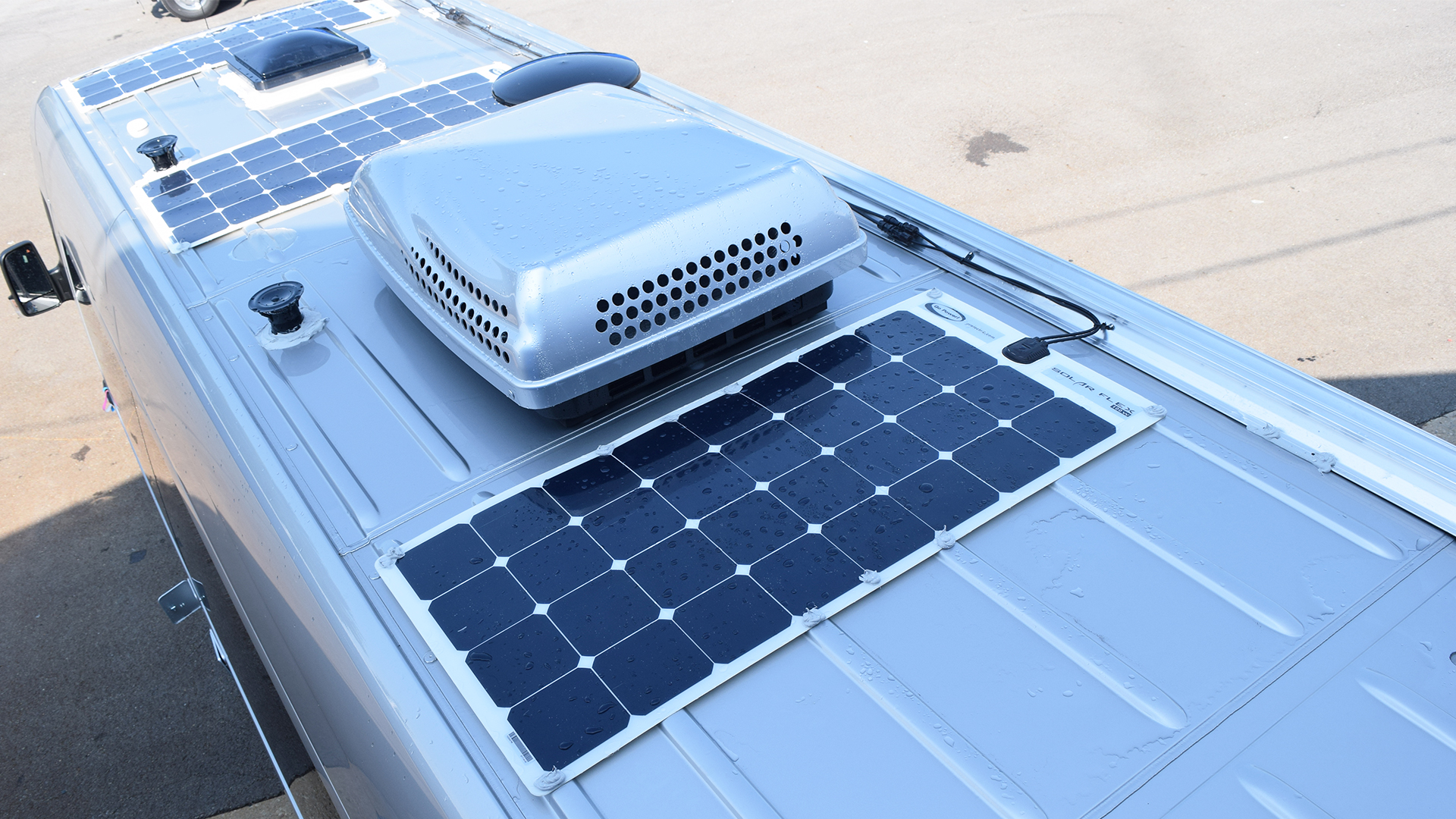
Since 2017, every Airstream travel trailer has come pre-wired for the installation of solar panels. Airstream Interstate 24 and Atlas travel coaches are delivered with a 100-watt solar panel. The Interstate 19 includes a 50-watt solar panel that will keep the chassis battery charged when the engine is turned off.
As a rule of thumb, your solar panels will generate electricity for an average of four hours per day on an annual basis. A solar charge controller protects the batteries from being overcharged by disconnecting the solar power feed when it senses that the batteries are fully charged. The control reconnects the system when your battery levels have dropped enough to accept more current.
An electric field is formed when opposite charges are separated. This separation is accomplished in the cells by coating the two pieces of silicon with materials that give each a positive or negative electrical charge. The result is an electric field between the two layers of silicon. When a photon of sunlight breaks an electron free, the electric field pushes the electron out of the field, where a metal plate is waiting to collect the released electrons and transfer them to the wiring of your solar system. Just as rainwater from a roof can be directed into collection barrels for later use, the juice that flows down the wires from those rooftop solar panels, through a solar charge controller and gathers in your Airstream’s batteries.
Since 2017, every Airstream travel trailer has come pre-wired for the installation of solar panels. Airstream Interstate 24 and Atlas travel coaches are delivered with a 100-watt solar panel. The Interstate 19 includes a 50-watt solar panel that will keep the chassis battery charged when the engine is turned off.
As a rule of thumb, your solar panels will generate electricity for an average of four hours per day on an annual basis. A solar charge controller protects the batteries from being overcharged by disconnecting the solar power feed when it senses that the batteries are fully charged. The control reconnects the system when your battery levels have dropped enough to accept more current.
 Your batteries store electricity as DC electricity, which can handle many tasks, such as keeping the lights on, ventilation fans running and recharging your USB-powered electronic devices. For bigger chores — running the air conditioning, or using appliances with motors and heating elements, for example — you need AC power (or a huge battery bank and power inverter). Fortunately, your Airstream’s power inverter can convert the batteries’ DC to AC to run the AC outlets in your Airstream.
If you plan to boondock, it’s imperative to know how much electricity you need to adventure as you wish and how much of that juice your Airstream’s solar power system can deliver. That information can be gathered through an energy audit. Simply list all the systems and electric items (TV, sound system, et cetera) you want to be able to use while off-grid and add up the watts those things consume per hour. You can use that data to determine how much solar output and how many batteries you need to power your untethered adventures.
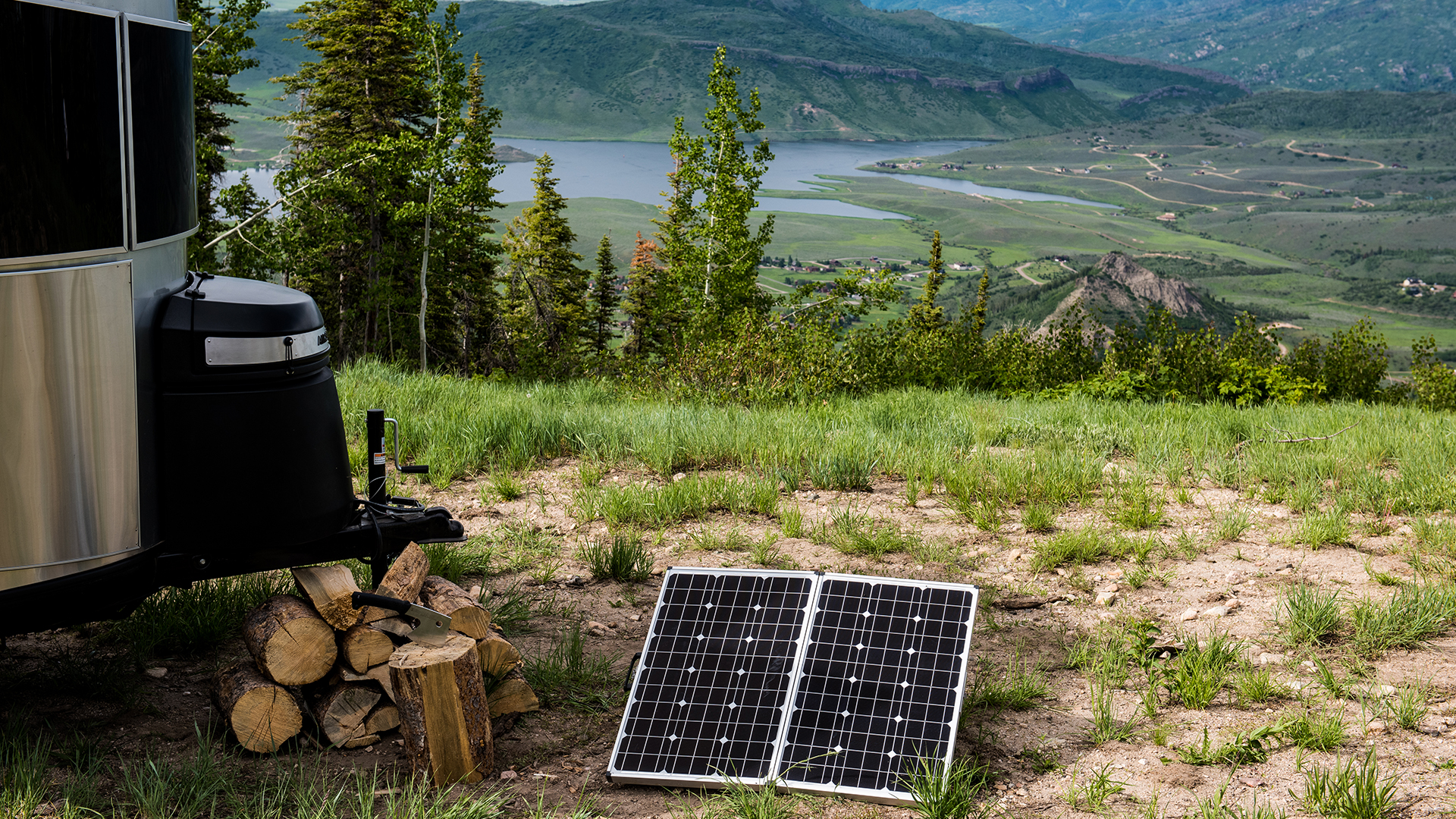
The number of solar panels you can install on your Airstream will vary depending on your model’s available roof space. Your late-model Airstream (2017 or later) will also have a connector at the front end that enables you to connect a ground-based solar panel. This feature is handy when you are camped under shade but still need to power up.
Your choice of batteries to hold your solar harvest will depend in large part on your Airstream lifestyle.
Your batteries store electricity as DC electricity, which can handle many tasks, such as keeping the lights on, ventilation fans running and recharging your USB-powered electronic devices. For bigger chores — running the air conditioning, or using appliances with motors and heating elements, for example — you need AC power (or a huge battery bank and power inverter). Fortunately, your Airstream’s power inverter can convert the batteries’ DC to AC to run the AC outlets in your Airstream.
If you plan to boondock, it’s imperative to know how much electricity you need to adventure as you wish and how much of that juice your Airstream’s solar power system can deliver. That information can be gathered through an energy audit. Simply list all the systems and electric items (TV, sound system, et cetera) you want to be able to use while off-grid and add up the watts those things consume per hour. You can use that data to determine how much solar output and how many batteries you need to power your untethered adventures.
The number of solar panels you can install on your Airstream will vary depending on your model’s available roof space. Your late-model Airstream (2017 or later) will also have a connector at the front end that enables you to connect a ground-based solar panel. This feature is handy when you are camped under shade but still need to power up.
Your choice of batteries to hold your solar harvest will depend in large part on your Airstream lifestyle.
 Lithium batteries are arguably the best choice for those who plan to spend a lot of time off the grid. They can store more usable energy than a comparable lead acid battery. Lithium batteries are more expensive but last longer than other options — up to 10 years. You should probably know that these otherwise excellent batteries can be slow to charge in cold weather.
A less expensive option is the AGM or Absorbed Glass Mat battery. They are maintenance-free and typically have a longer life than standard lead-acid batteries. However, AGMs should only be discharged to 50% of their capacity, which means you need more AGM than lithium batteries to get the same storage capacity.
A lead-acid battery is the least expensive option for your Airstream, but their water levels must be monitored regularly and have a shorter life than lithium or AGM batteries.
Lithium batteries are arguably the best choice for those who plan to spend a lot of time off the grid. They can store more usable energy than a comparable lead acid battery. Lithium batteries are more expensive but last longer than other options — up to 10 years. You should probably know that these otherwise excellent batteries can be slow to charge in cold weather.
A less expensive option is the AGM or Absorbed Glass Mat battery. They are maintenance-free and typically have a longer life than standard lead-acid batteries. However, AGMs should only be discharged to 50% of their capacity, which means you need more AGM than lithium batteries to get the same storage capacity.
A lead-acid battery is the least expensive option for your Airstream, but their water levels must be monitored regularly and have a shorter life than lithium or AGM batteries.
Airstream Power 101
Part 3: Solar Power
Futurist and science fiction writer Arthur C. Clarke famously observed that any sufficiently advanced technology is indistinguishable from magic. That certainly applies to the solar power system in your Airstream, which takes rays of sunlight and turns them into enough electricity to let you adventure far from campground hook-ups. It sure looks like magic, but it’s just leading-edge technology specifically tailored to your Silver Bullet. Whether you’ve already harnessed the sun or are considering doing so, the more you know about Airstream’s solar capabilities, the more benefit you can reap from them. So, let’s pull back the curtain and take a look at the technology behind the… magic. The centerpiece of any solar power system is the solar panels. These roof-mounted marvels are collections of photovoltaic cells. The panel’s component cells convert sunlight into electricity by creating what’s called an electric field, a place where photons, which are particles of light, can break electrons free from atoms.
An electric field is formed when opposite charges are separated. This separation is accomplished in the cells by coating the two pieces of silicon with materials that give each a positive or negative electrical charge. The result is an electric field between the two layers of silicon. When a photon of sunlight breaks an electron free, the electric field pushes the electron out of the field, where a metal plate is waiting to collect the released electrons and transfer them to the wiring of your solar system. Just as rainwater from a roof can be directed into collection barrels for later use, the juice that flows down the wires from those rooftop solar panels, through a solar charge controller and gathers in your Airstream’s batteries.
Since 2017, every Airstream travel trailer has come pre-wired for the installation of solar panels. Airstream Interstate 24 and Atlas travel coaches are delivered with a 100-watt solar panel. The Interstate 19 includes a 50-watt solar panel that will keep the chassis battery charged when the engine is turned off.
As a rule of thumb, your solar panels will generate electricity for an average of four hours per day on an annual basis. A solar charge controller protects the batteries from being overcharged by disconnecting the solar power feed when it senses that the batteries are fully charged. The control reconnects the system when your battery levels have dropped enough to accept more current.
Your batteries store electricity as DC electricity, which can handle many tasks, such as keeping the lights on, ventilation fans running and recharging your USB-powered electronic devices. For bigger chores — running the air conditioning, or using appliances with motors and heating elements, for example — you need AC power (or a huge battery bank and power inverter). Fortunately, your Airstream’s power inverter can convert the batteries’ DC to AC to run the AC outlets in your Airstream.
If you plan to boondock, it’s imperative to know how much electricity you need to adventure as you wish and how much of that juice your Airstream’s solar power system can deliver. That information can be gathered through an energy audit. Simply list all the systems and electric items (TV, sound system, et cetera) you want to be able to use while off-grid and add up the watts those things consume per hour. You can use that data to determine how much solar output and how many batteries you need to power your untethered adventures.
The number of solar panels you can install on your Airstream will vary depending on your model’s available roof space. Your late-model Airstream (2017 or later) will also have a connector at the front end that enables you to connect a ground-based solar panel. This feature is handy when you are camped under shade but still need to power up.
Your choice of batteries to hold your solar harvest will depend in large part on your Airstream lifestyle.
Lithium batteries are arguably the best choice for those who plan to spend a lot of time off the grid. They can store more usable energy than a comparable lead acid battery. Lithium batteries are more expensive but last longer than other options — up to 10 years. You should probably know that these otherwise excellent batteries can be slow to charge in cold weather.
A less expensive option is the AGM or Absorbed Glass Mat battery. They are maintenance-free and typically have a longer life than standard lead-acid batteries. However, AGMs should only be discharged to 50% of their capacity, which means you need more AGM than lithium batteries to get the same storage capacity.
A lead-acid battery is the least expensive option for your Airstream, but their water levels must be monitored regularly and have a shorter life than lithium or AGM batteries.
For more information about your Airstream’s solar power system, check out Airstream Academy. This comprehensive knowledge base is jam-packed with answers and information about every aspect of operating and maintaining your Airstream Travel Trailer or Touring Coach.