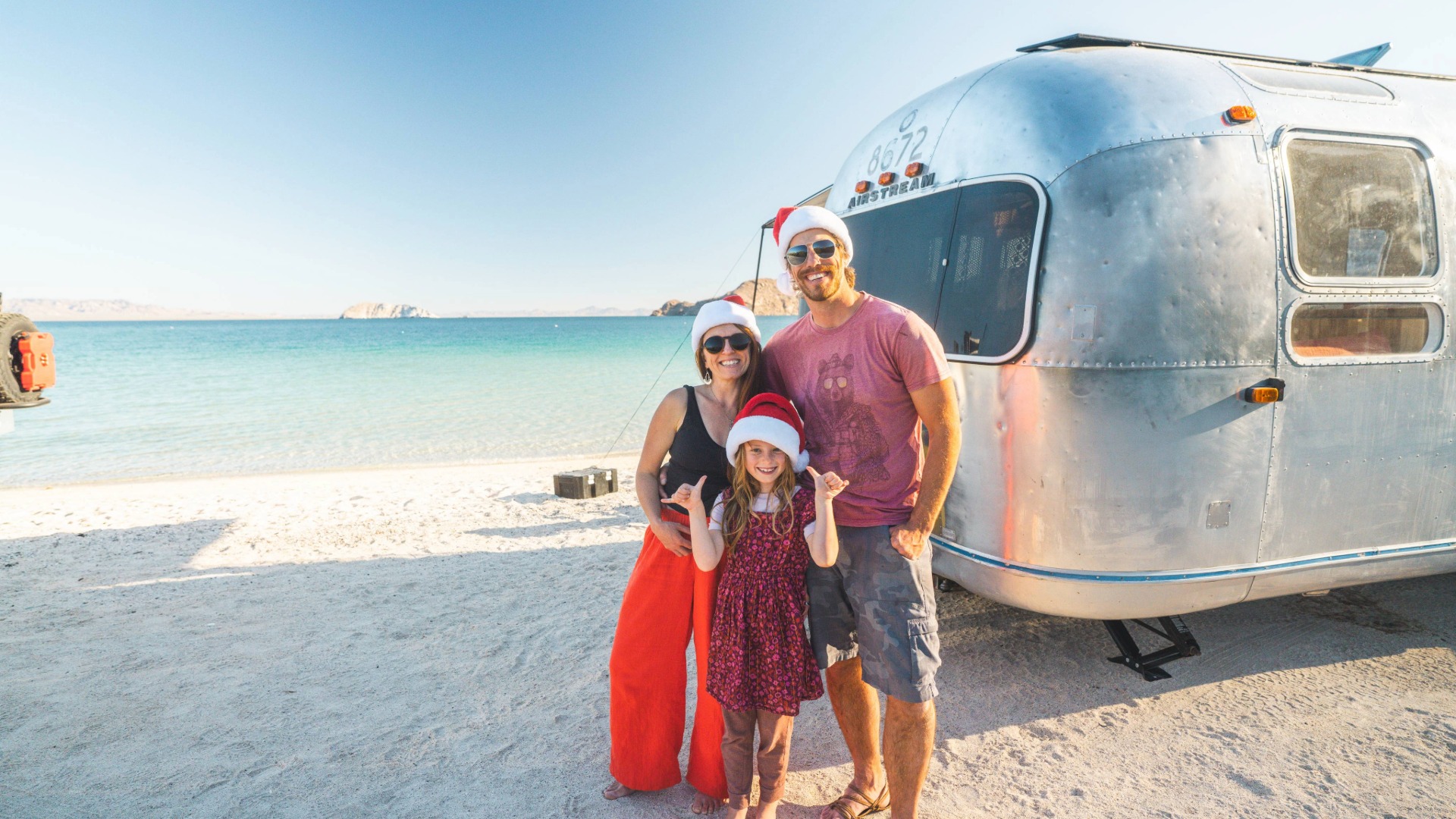
Jacob Moon and his family love taking their Airstream down to Mexico’s Baja peninsula for the ideal weather, endless recreation, and slower pace of life. “You wake up, watch the sunrise, drink your coffee, then go fish or play on the beach or paddleboard—you just take it slow,” Jacob says. “You’ve got to go slow down there.
Jacob Moon has been making the trek from his home in Utah, down the Baja peninsula for more than a decade. He’s made the trip in all kinds of vehicles, but for the last couple of winters he and his family have taken their 1970 self-renovated Overlander travel trailer, and it’s made the trip even more fun than ever.
When Jacob bought a 1970 Airstream Overlander more than two years ago and towed it from Texas to his home in Utah, he knew he was signing up for a major renovation project—that was the point. Even so, the scope of the work surprised him. The challenges were bigger than expected, but so was the payoff.
This winter, for the second year in a row, he, his wife, and their daughter hit the road with the restored vintage Airstream, heading down to Baja in search of sunshine and slow, restorative days.
:quality(85):smart(true))
“I think a lot of people make the mistake, and rightfully so, of driving all the way down the peninsula,” Jacob said. “They’re always driving and always moving. And I do think it’s worth it, once or twice, to go all the way north to south, but after you’ve done that, it’s nice to pick your place—your beach, and stay in one place for a week, minimum. Soak up the Baja vibe of just being there.”
Jacob and his family like to stay mostly in the middle of the peninsula—in the area between Guerrero Negro to Loreto; specifically, Bahía Concepción. There, the Sea of Cortez is very calm, and there aren’t as many crowds.
Jacob put a lift on his Airstream so that it’s 5-inches higher off the ground. “That makes it easier to take it to a lot of different places,” Jacob said. Their Baja routine is to pick a beach that looks good for fishing and boating, plant the Airstream somewhere with exceptional views, and set out exploring.
:quality(85):smart(true))
“I’ve taken a lot of setups down to Baja, but my favorite setup is having the Airstream as a base camp. I like to have a comfortable home to come back to,” Jacob said. “We like to park it on Concepción, because there's always people around that we trust—friends and people we meet—keep an eye on it.” Then Jacob and the family can take their overlanding truck farther down the coast, where it gets rocky and more difficult to maneuver.
“I'll drive over to a beach, go down the coast about five miles, and do a little fishing. Having a truck that can go anywhere, and the Airstream to come back to, is perfect. My family has a comfortable place to stay while I go on my little adventures.”
:quality(85):smart(true))
Jacob hasn’t always been someone who enjoys the beach life. For a long time, he thought it was kind of boring, so he made it more interesting. “I'm someone who needs to be doing something all the time,” Jacob said. “So I started bringing a little inflatable boat with a motor. Just six horsepower. This way I can explore the coastline a little more and go out to the little islands and beaches.”
Jacob has also gotten into freediving and spearfishing. “It’s been phenomenal, and I’ve gotten pretty good at it. I don’t even need to catch anything; I’m just happy out there swimming with the fish and seeing what I see.”
:quality(85):smart(true))
Spearfishing has taught Jacob to take note of the different personalities of the fish. “I feel like I’m part of the environment. Instead of tossing a hook into that other world and pulling something out, I'm actually in that world, paying attention to all the sea life and seeing what happens. I’ve learned that basically anything can swim up on you, which is fun—I've seen some amazing stuff out there.”
On their most recent trip, Jacob and his family went down to Baja for two weeks and took several freezers so that they could bring fresh fish home. “We brought a vacuum sealer and caught a whole bunch of fish, sealing up grouper, snapper—making fresh ceviche on the beach, which is one of our big traditions.”
Go Prepared
Jacob learned a lot about parking in sand early on. “Our first couple trips, we had a van, and I didn't know anything about sand beaches and whatever else, so I learned pretty fast,” Jacob said. “First trip we went down and we drove out onto a beach next to a small town: maybe 150 people. Very small town in a very remote area. And we drove out onto the beach and got stuck immediately.”
Locals came over after Jacob had been trying to dig out for a little while, and taught him how to stack rocks and create a little ramps and deflate his tires. “Now we go prepared for all kinds of scenarios,” Jacob said. “You just must take that stuff with you. If you're down there and need any sort of specialty parts, you might not be able to find them. There just aren’t many specialty resources on the entire peninsula.”
Jacob has learned a lot about being resourceful, taking tools, and knowing what it feels like when a vehicle is going to get stuck. These days he considers himself a bit of an expert, and is probably the exact person you want to run into if you get yourself stuck.
There aren’t many things that stress Jacob out in Baja—just the opposite. It’s a place he goes to restore his energy, relax, and enjoy the water.
:quality(85):smart(true))
As Jacob and his family eat their Baja fish for the next few months back in Utah, they’ll already be dreaming of their next trip down. “We really appreciate having the Airstream on these adventures,” Jacob said. “It just makes things so much more comfortable and fun.”